Introduction to parallel computing
Introduction
While most people see R as a slow programming language, it has powerful features that dramatically accelerate your code 1. Although R wasn’t necessarily built for speed, there are some tools and ways in which we can accelerate R. This chapter introduces what we will understand as High-performance computing in R.
High-Performance Computing: An overview
From R’s perspective, we can think of HPC in terms of two or three things:2 Big data, parallel computing, and compiled code.
Big Data
When we talk about big data, we refer to cases where your computer struggles to handle a dataset. A typical example of the latter is when the number of observations (rows) in your data frame is too many to fit a linear regression model. Instead of buying a bigger computer, there are many good solutions to solve memory-related problems:
Out-of-memory storage. The idea is simple, instead of using your RAM to load the data, use other methods to load the data. Two notewirthy alternatives are the bigmemory and implyr R packages. The
bigmemorypackage provides methods for using “file-backed” matrices. On the other hand,implyrimplements a wrapper to access Apache Impala, an SQL query engine for a cluster running Apache Hadoop.Efficient algorithms for big data: To avoid running out of memory with your regression analysis, the R packages biglm and biglasso deliver highly-efficient alternatives to
glmandglmnet, respectively. Now, if your data fits your RAM, but you still struggle with data wrangling, the data.table package is the solution.Store it more efficiently: Finally, when it comes to linear algebra, the Matrix R package shines with its formal classes and methods for managing Sparse Matrices, i.e., big matrices whose entries are primarily zeros; for example, the
dgCMatrixobjects. Furthermore,Matrixcomes shipped with R, which makes it even more appealing.
Parallel computing
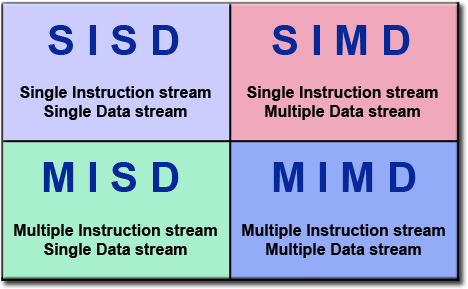
We will focus on the Single Instruction stream Multiple Data stream.
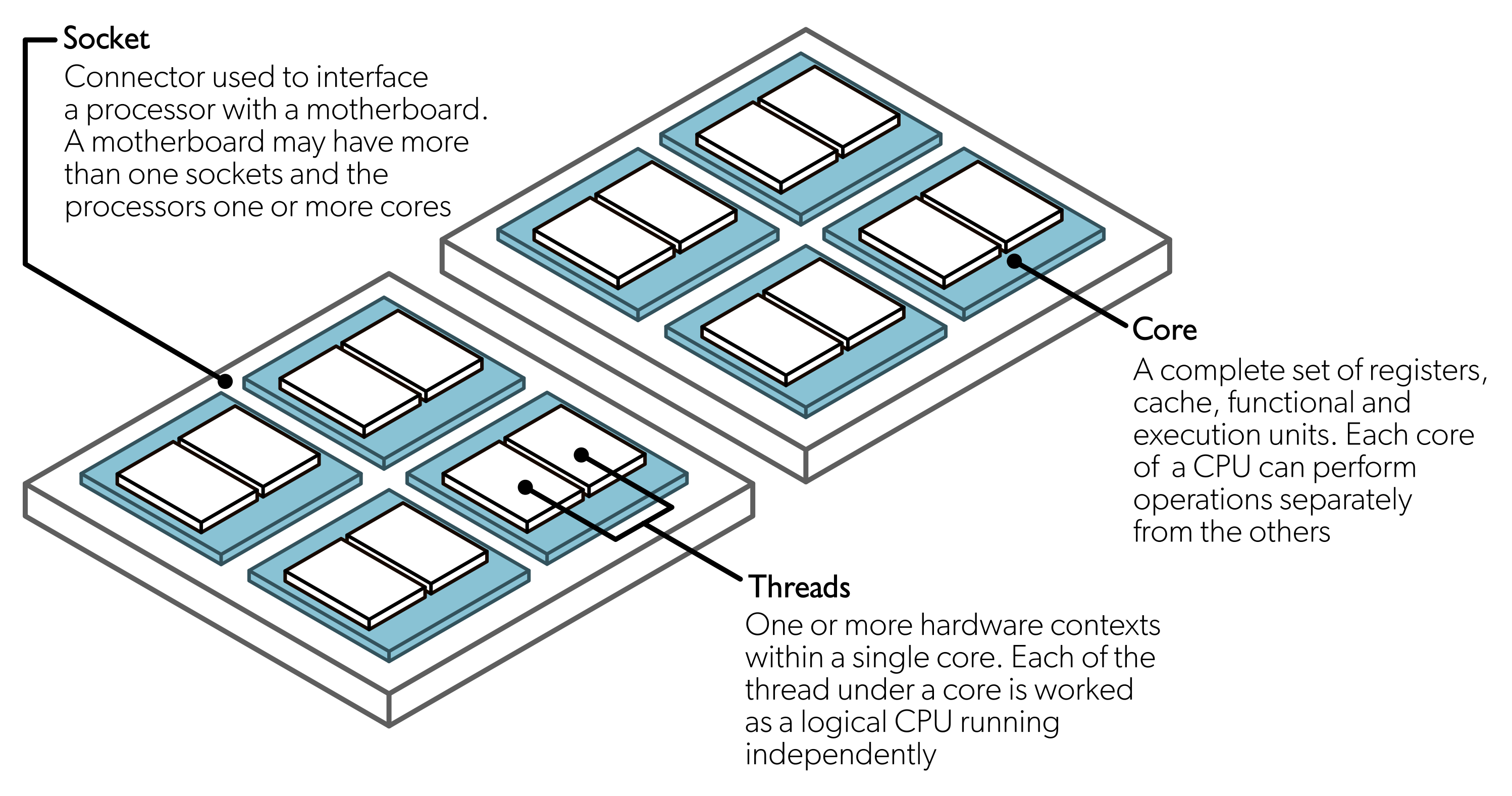
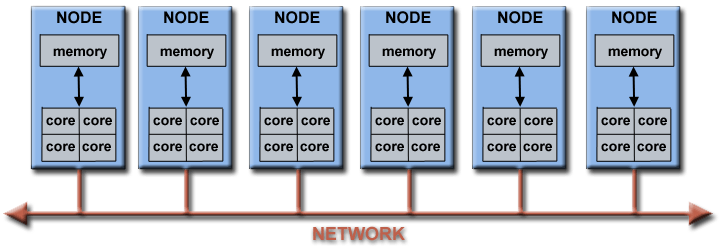
In general terms, a parallel computing program is one in which we use two or more computational threads simultaneously. Although computational thread usually means core, there are multiple levels at which a computer program can be parallelized. To understand this, we first need to see what composes a modern computer:
Streaming SIMD Extensions [SSE] and Advanced Vector Extensions [AVX]
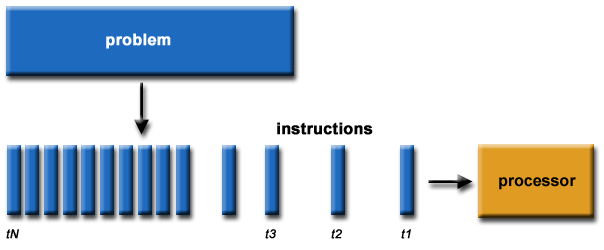
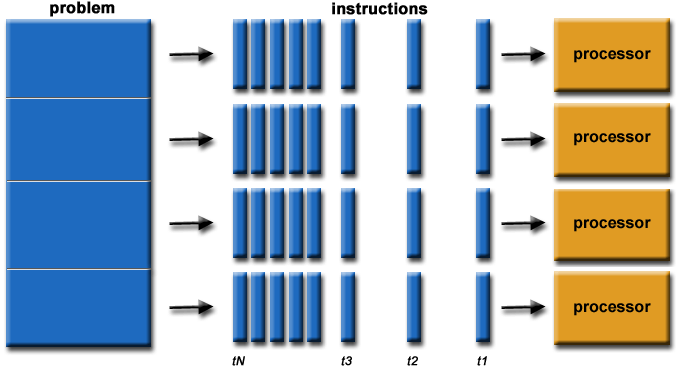
Serial vs. Parallel
High-performance computing in R
Some vocabulary for HPC
In raw terms
Supercomputer: A single big machine with thousands of cores/GPGPUs.
High-Performance Computing (HPC): Multiple machines within a single network.
High Throughput Computing (HTC): Multiple machines across multiple networks.
You may not have access to a supercomputer, but certainly, HPC/HTC clusters are more accessible these days, e.g., AWS provides a service to create HPC clusters at a low cost (allegedly, since nobody understands how pricing works)
GPU vs. CPU
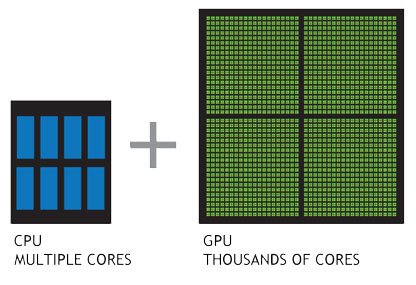
- Why use OpenMP if GPU is suited to compute-intensive operations? Well, mostly because OpenMP is VERY easy to implement (easier than CUDA, which is the easiest way to use GPU).3
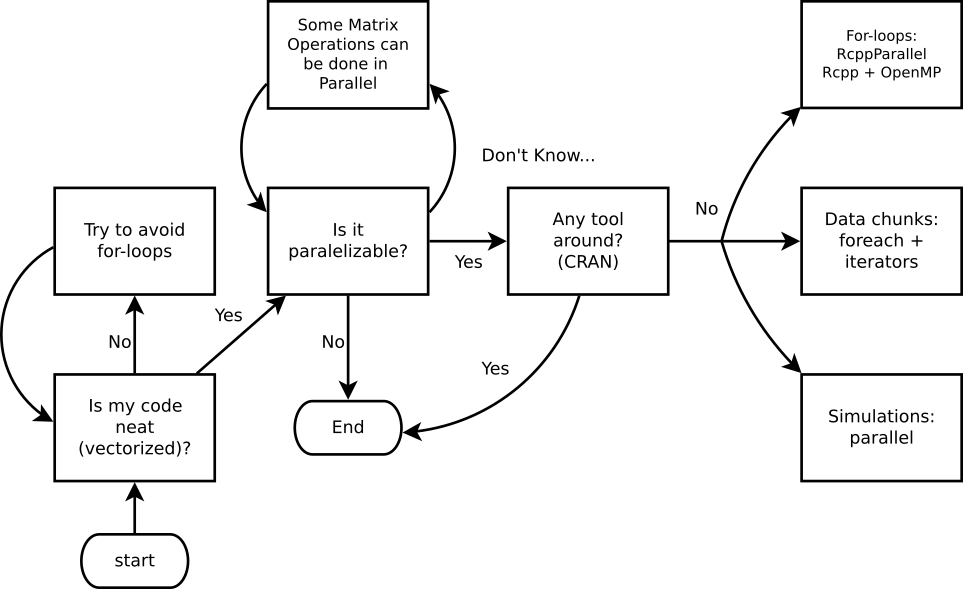
When is it a good idea?
Parallel computing in R
While there are several alternatives (just take a look at the High-Performance Computing Task View), we’ll focus on the following R-packages for explicit parallelism:
parallel: R package that provides ‘[s]upport for parallel computation, including random-number generation’.
future: ‘[A] lightweight and unified Future API for sequential and parallel processing of R expression via futures.’
Rcpp + OpenMP: Rcpp is an R package for integrating R with C++ and OpenMP is a library for high-level parallelism for C/C++ and FORTRAN.
Others but not used here
And tools for implicit parallelism (out-of-the-box tools that allow the programmer not to worry about parallelization):
gpuR for Matrix manipulation using GPU
tensorflow an R interface to TensorFlow.
A ton of other types of resources, notably the tools for working with batch schedulers such as Slurm, and HTCondor.
Nonetheless, this claim can be said about almost any programming language; there are notable examples like the R package
data.table(Dowle and Srinivasan 2021) which has been demonstrated to out-perform most data wrangling tools.↩︎Make sure to check out CRAN Task View on HPC.↩︎
Sadia National Laboratories started the Kokkos project, which provides a one-fits-all C++ library for parallel programming. More information on the Kokkos’s wiki site.↩︎